J. Erwine (a newly expectant Dad) has announced that The Martian Wave Science Fiction magazine is now available. I don’t remember if I get a free copy or not.
My story The Reefs of Jove is in it. The story is about adventure while exploring the high atmosphere of Jupiter in a dirigible. The cover could almost be an illustration of part of the story.
I can hardly wait to see a copy. Sorry, the story is not available online. I wonder if I could ask J. would put it up on the SamsDot site is a kind of teaser for the magazine?
Here is the lineup:
Stories:
Steve De Beer: Adaptor
Tyree Campbell: Somewhere With Mornings
Dan Thompson: Prize Crew
Keith P. Graham: The Reefs of Jove
Patty Jansen: Luminescence
Bret Tallman: Into the Silence Flies a Moth
Rick Novy: The Pillars of Europa
Lawrence Dagstine: The Great Martian Depression
poems:
Shelly Bryant: Bypassed
Justin Bohardt: The Barren Wastes
s.c. virtes: another pit for sale
Marge Simon: A Hollander’s Secret Weapon: 1609
Marge Simon: Hindsight
Steve over at the Crotchety Old Fan has one of those omnibus posts that covers soup to nuts. Included in it is the factoid that if you want to get lots of traffic, just include the phrase XXX Heinlein in your tags.
He mentions me as a someone to vote for in the Hugo awards short story nominations. – Thanks, Steve.
He also suggests that one might want to consider Fred Pohl’s The Way the Future Blog for best fan writer. I was going to vote for Steve anyway, but I really enjoy Fred’s musings on the early days of SF, so I’ll vote for him, too.
Steve makes lots of sensible recommendations. Steve and I would beg you please do not vote for Avatar in the movie class. The story is an embarrassment to anyone striving to be a Science Fiction author.
This is a Gnome Press 1959 edition of one of the master’s early collections. I just finished rereading this a few weeks ago.
Signed copies of Heinlein books go for a couple of thousand, unless they are the copies of Friday he signed at one of the cons. He signed lots of them and Friday is not considered a Heinlein classic.
I was once at a party where I had a conversation with a woman artist about Robert A. Heinlein. When I told her that he was my favorite writer, she told me I was an idiot and that Heinlein was a fascist woman hater. This is an attitude that I have come across from time to time, especially from women. It could not be further from the truth, and I don’t know how this has happened. I have read everything that Heinlein has written at least four times and one or two of his books as many as 20 times. He is not a woman hater. He is not a fascist. To me his an intelligent and reasonable observer.
At the The Lensman’s Children blog, Sarah Hoyt has an article defending Robert A. Heinlein. She discusses Heinlein’s problems with women and how they are dead wrong. It does my heart good to read something like this.
Here’s a sample:
But I was raised by Heinlein through his books, and I hope at least the spirit and the intention of the search for truth and individual freedom remains in my work. As well as the certainty that it’s always easier to be a live lion than a live lamb or a dead lion.
There was a discussion about the realness of SF over at one of the Nanowrimo forums. It seems that they read my “Laws Science Fiction” page and I was trashed – the page and me personally.
Also – I wouldn’t worry too much about that website. Personally, I think their “laws” are a load of crap, and that anyone who talks about “laws of writing” in that way should probably go take a hike. :-p
And another:
That website is crappy. Just reading the laws show their ignorance of Science Fiction. I doubt they’ve ever read Asimov.
My own personal opinions are stated clearly in the list of laws, so you might be able to guess what I think about the kind of writing that these people produce.
I imagine that I have sold more stories than everyone on that thread combined. In my brief stint as an editor, I had to read a lot of the stories that these people obviously prefer, and my eyes still hurt when I think about it.
The web site referenced has some good points to make, but it takes some uncomfortable hard lines on some things.
The author then goes on to describe how his or her novel is about an alien that (in my view) is really a human in a rubber suit. If you want to write about humans. Using SF to hide your true intentions seems like laziness to me. I guess some people find it easier to cast a story in a an sf setting so they will not have to do the hard work of character development and creating believable conflicts and plots.
There was only one criticism to my list of rules that I could buy into. Writing SF is fun so writing a story that breaks all the rules, but is fun to write and read is the only excuse for not following the rules.
This give me the AHA moment and I will add a disclaimer at the end.
There is an article in Computer World about the future of super computers. They are talking about Exaflop systems.
Rudy Rucker, in his Software/Wetware books, discussed the future of computation and he felt that Teraflop machines would be common in the 2020s. Currently the fastest machines are Petaflop supercomputers.
The next highest step, Exaflop or 1,000,000,000,000,000,000 (that’s 18 zeros) floating point calculations per second is due around 2018.
No matter who you ask, an Exaflop exceeds the computing power of a human brain. Of course these super computers won’t be programmed to emulate a human brain, but they will be given problems that human genius cannot solve just by thinking.
The article talks about the Energy Department using this computer for Grid control and possibly designing an Atomic Fusion power generator. (This on the day it was announced that we are running out of Uranium for fission reactors.)
The computers will be used for the very complicated systems computing used to predict weather, but I think that analysis of the human genome and the modeling of human biology with the idea of curing disease will be important. The computer will be capable of designing billions of possible drugs and then testing them on genetic models refining the results so that shortly after these Exaflop computers appear there will be cures for all diseases.
2018, by the way, is right in line with estimates for the Singularity. I want to believe!
Steve Davidson turned me on to the fact that there is unusually low turnout for the annual voting for the Hugo Award, which is like an academy award except that it is for SF.
I did a little research based on Steve’s model for “Rocking the Hugos” and I was able to discover that in recent years it has taken under 20 votes to get a nomination on the final Hugo ballot. Although there are more than 500 nominations for each category, the minimum to get on the ballot was 17 a year ago. That means that all you need to appear on the final Hugo ballot is about 20 nominations. Once on the ballot you could have a real shot at winning a Hugo or at least boosting sales with a “Hugo Nominee” banner on you book, magazine or short story.
The gotcha is that it costs $50 to get yourself a voting membership in the World Science Fiction League. People who would gladly spend $50 on a weeks worth of smokes decide that it is not worth it to hack the system. You get all kinds of bling and extras for that $50, but $50 is too much.
Unless I can find 20 people with $50 burning a hole in their pockets, I can give up on “Best Short Story” this year. I would have been an honor to be nominated.
Fred Pohl linked back to the post on the Science Fiction League. This was nice of him and so far I have seen a dozen hits. I hope y’all come back now.
The project wonderful ads have started generating a (very) little income, but I am pleased with the ads. Currently they are for a fairly unique site that lets you continue a shared story by writing posts. I think I’ll even click on it and lurk. It does look like fun.
I know that four or five SF writers and editors have had reservations about advertising on their blogs and zine sites because the ads are out of their control. Specifically the keyword Fantasy often gets some weird ads, as you can imagine. With the project wonderful website you approve the ads before they appear on your site. The downside is that the income is pretty low for small sites. Higer volume sites (over 1,000 hits a day) can make more.
I have started advertising my Name a Star site using project wonderful and I am getting a few click-throughs. The price is quite a bit lower than adwords and I can pick and choose the sites where I want the ads to appear. If you need to advertise a site, on a budget, then project wonderful is perfect. There are numerous gaming and spec-fic sites to choose from (J. Erwine and Ephemeris, please note!)
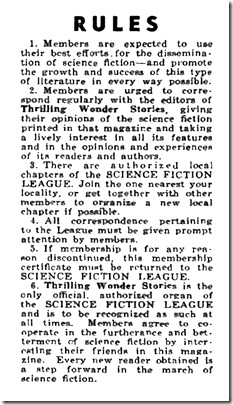
Frederik Pohl has a nice article about The Science Fiction League. I found an original SF League membership card on eBay and I made copies of it. I put a high resolution copy of the card into a standard printer business card template so you can print your own cards.
WARNING: this is nigh onto 30 megs of download and may take a while.
I received 13 critiques from critters.org of my short story “The Perfect Gold”. I used this story as a barometer of how the critiques might help me because it was one of the first stories I wrote after a 35 year hiatus. I wrote it early in 2003 and it appeared online in Atsoise (now defunct) in February of 2004. It had 5 rejections before it was accepted and I believe that this is because of my ignorance of how editors expected a story to be written.
I made lots of mistakes in “The Perfect Gold”. I was trying to write in a fairly remote omniscient viewpoint, which is an older style and not acceptable today. Currently, editors want a tight personal viewpoint, almost first person (but they don’t like first person). Another mistake was that I had a break in the middle of the story where the main character leaves the scene to get something, but it chops off the flow until the character returns. In another break I spend some time describing the background and history of one of the characters, almost as though it were a footnote, and this disrupts the narrative. I had lots of trouble with the language. My words flow a little smoother now, but I remember at the time that I was concerned that the sentences seemed like lines from a technical manual with lots of “she did this” and “then he did this”. This computer programmer approach to narrative has been somewhat abated, but I still tend to write in syllogisms.
The critiques I received were of different kinds. One had an attached word document that cannot be opened due to viruses. Four were people who told me that they really enjoyed the story and went on to tell me their favorite parts (useless other than for moral building). Three people hated the story or thought it was boring. It seems that I wrote a “mood” piece. The people that did not like the story wanted less emotion and more blood and guts. The story has an emotional impact, but it is not an O Henry type story with a twist or revelation at the end (I wanted to write a story like “The Dead” by Joyce).
About three quarters of the critiques had valid remarks. They found numerous typos that I did not see. They complained about the narrative breaks that interrupted the flow. Many complained about my short choppy declarative sentences. I am almost tempted to rewrite the story, give it different title and try to resell it as new. I’ve done this with other stories, but right now I have new ideas, and I have dozens of stories that I have yet to write before I rehash older stuff.
The critters experience has been a good one overall. When I first started writing, I would not have found it useful because I would have disagreed with some of the conclusions. My attitude today is that most editors have had their souls corrupted by the Clarion brainwashing and there is nothing I can do about it. The Clarion workshops have created a static standard that renders classic short stories by Bradbury, Clarke, and Heinlein as “bad”. If I am to publish stories, they must fit into the little box created by advocates of Clarion and the Turkey City Lexicon.
Now that I have been through the critters process, I will be leaving the group. I was going to put my stories “Carnivale of Blood”, “Nigerian Soul”, and “The Reefs of Jupiter” through the process, but it takes too long for too little. In order to get a critique you have to submit 10 critiques, which I find stressful, and then wait 45 days. I’d have to wait four and a half months to get a three stories critiqued, and I usually write one or two stories each month.
I was thinking about hijacking the process in order to speed things up by using four or five different emails and writing a critique a week for all of them, but this would be too much like work. I am far from the right person to criticize a story (pot calling kettle…). I didn’t like most of the stories that I critiqued so it was hard being diplomatic.
I will have to prevail on family and friends to edit my stories. I just don’t see my typos, grammar and syntax mistakes. This would have been a good use for critters, but I don’t have the patience.

I’ve spent the last two weeks tramping through Middle Earth. (Listening to mp3s on Justine’s iPhone.) Gollum just fell into the crack of doom and I’ve had it with Hobbits for another year. I have read or listened to LOTR probably over 100 times. There was a time, 20 years ago, that I know I passed the 50 count just on reading. At that time I obtained the tapes and listened two or three times a year as I commuted to work. I since found the audio in MP3 format.
I can get back to reading, again. I have rediscovered the simple pleasures of reading since I started taking the bus in the morning. My six months’ bus anniversary came and passed without celebration (I was still bummed about Christmas.)
Monday I start reading Black Glass, by John Shirley. This is billed as Shirley’s Lost Cyberpunk Novel. I like Shirley’s Science Fiction and I am a Cyberpunk kind of guy. Last Year I read Shirley’s Demons, and a couple of months ago I read an old copy of City Come a Walking by Shirley, and I thought it was excellent. I should reread his Eclipse books, since it has been a few years. I went through the link above and got a signed copy of Black Glass at the regular price, although I was raped on shipping. Media mail should have been about $1.50 not $6.50.