Jim Shannon has been making some interesting arguments in the comments to a post that I did a little earlier. I thought that I would bring it up to the top with another post so Jim, J, and I could continue the debate. The chart below is a longer scale chart that shows a natural 100,000-125,000 year cycle of ice ages and warm periods. This chart is the one that critics point to when they try to debunk global warming. Critics of global warming claim that the current warming trend is part of this cycle.
My contention is that the cycle in this chart is 100,000 years. We are talking about a local and radical change with a span of under 100 years that doesn’t even show up on the scale of this chart. In other words the critics are trying to say there are no apples by pointing to the oranges. OSC’s criticism of the slanted statistics of Global Warming, that Shannon linked to, are not a critique of the science so much as a critique of the scientists. It reeks of Ad Hominem arguments. Card argues the politics of Global Warming and knows nothing about the science. (how’s that for ad hominem!)
I think it is common sense to think that the huge amount of greenhouse gases that industries pour into the atmosphere combined with the drastic losses of the rain forests and die-backs of ocean plankton has an impact on the earth. The degree of impact is the question that is under argument and the overwhelming majority of climatologists feel that global warming is real and dangerous. The vocal minority of dissidents are usually arguing politics rather than science.
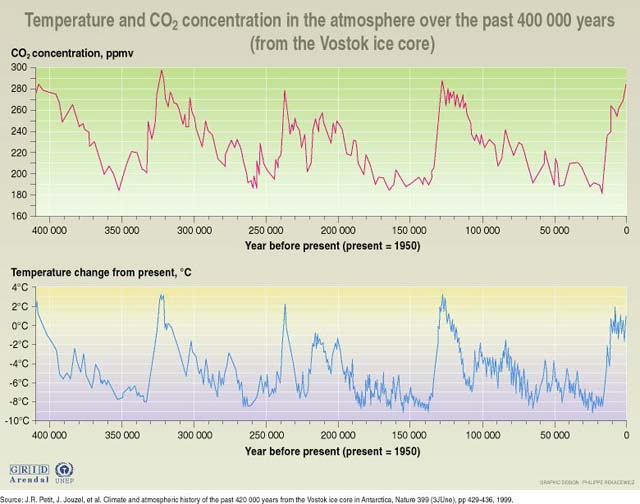
Temperature and CO2 concentration in the atmosphere since 400 000 years
Notes: This post references Jim Shannon’s Blog, J Alan Erwine’s Blog, Neal Asher’s Blog and an entry on Orson Scott Card’s blog. Let’s here it guys!
4 Comments
We can even continue the debate on my blog, because I’ve just posted my take on this. I do have to admit that mine is more of an opnion piece, in that I didn’t point to specific data. As I see it, I’m writing a blog…not a term paper.
Graphs are always interesting, because with most of them, you can set the scale up to argue on either side of an issue.
I think the most important thing to think of is does it really matter whether or not it’s humaity’s fault? If there’s any chance that it is, shouldn’t we be trying to change things instead of arguing who or what is to blame?
Also, if we get away from using oil, that would stabilize the world in other ways as well. Let’s face it, the money we’re spending on oil is helping to fund terrorism in one way or another…maybe not directly, but some of that money gets to them. Also, we’re beginning to see that renewable energy is a real possibility. Wouldn’t it be nice to clean up the air, whether or not global warming is real or not?
I’ll add the links to you and OSC.
You bring up a good point, though. We can see raw data about the recent sharp increase in CO2 and temperature, but can we attribute it to man’s effects on the environment? All the charts show the trend continuing, but in the future we can’t be sure, maybe it’s just a blip.
I assume that the CO2 occurs because of emissions and loss of biomass to recycle the CO2 back to O2. That’s just an assumption.
It will take a few hundred years to be sure. If we do nothing and the trend just keeps on going up, our grandchildren will be living under water, except for Denver, of course.
If we take charge and implement drastic cuts in emissions and it turns out the blip in warming was only temporary, then better safe than sorry. The oil companies will make marginally less profit for a few years, but we’ll live in a cleaner world with fewer cancers and children with asthma.
Nobody is arguing against global warming or climate change. This happens all the time in nature and one doesn't need to be a climatologic to have an opinion. It is still my opinion that global warming are all natural earth and solar cycles. If we went all the way with the Kyoto accord whole economies would collapse Canada's and America's and this current “crisis” is all about politics and money my friends.Case in point Our PM's minority Government is on a precipice at the moment. Harper want's to continue the mission in Afghanistan but the Bloc and the Liberals do not agree with the mission. If anyone of Harpers bills are defeated in the House of Commons we could go to another National election. Harper has been cozying up to the NDP (Far left) for support in case Harper's Government is called for an election over any non-confidence vote. The NDP said they'd support Harper if he does a better job on climate change. Now Harper is toting the “Green” tune. If Harper had a majority Government, he would have told the NDP where to go. It's not about politics? It's about politics and money. I can almost guarantee you that if the Kyoto accord gets its way you think the American economy is sliding now, you haven't seen anything yet. The environmental alarmists have grant money to think about. They need to advance a state of fear if they want to continue their funding. OSC may not be a scientist but he is a professional in his field and I respect that. By the same token, Canada's own Robert J Sawyer is also on the side of the alarmists to borrow OSC terminology. Yes I admit I'm not a scientist. This is a complex issue and way to large in scope for my limited intelligence but from my reading, and I've done a fair bit on the topic I'm leaning towards the global warming climate change as not a man made issue. Anyway I'm not out to debate on the subject and I'm trying hard as hell to give you guys the last word on the topic. I'm not trying to make enemies here so if you don't mind I'd rather just let it go.
Thanks
Jim-As I said on your blog, this is just a debate…no enemies will be made. I think Keith and I are both mature enough to realize that people have different opinions, and that we don’t know everything…even though we might think we do.
I think the American economy would have easily survived Kyoto had we not gotten involved in the quagmire of Vietnam…sorry, Iraq. We have major companies in America, including oil companies, that are asking Bush to put into place some of what Kyoto would have required. The only reason they don’t do it themselves is because their rivals wouldn’t have to, which would put their companies into financial difficulties.
In my completely uneducated opinion, the reason Canada is having problems is because they’re trying to follow the moronic policies of their neighbors to the south…